
K Sivan has to hasten the effort to bring in private players into satellite and rocket building and replicate India's software success in aerospace.

India is set to operationalise its own navigational system with the successful launch of IRNSS-1D, the fourth in the series of seven navigational satellites, onboard PSLV-C27 from Sriharikota on Saturday.

'When a Project Director is appointed, the whole organization -- including the Chairman ISRO -- works for his success. It is a lesson that has been of abiding value all through the other projects I have worked on,' recalls the late President, one of the earliest pioneers at ISRO.

India's observatory will be the fourth in space, after the Hubble, Russia's Spektr R and Suzaku of Japan.

According to ISRO officials, the spacecraft will be placed in a halo orbit around Lagrange point 1 (L1) of the Sun-Earth system, about 1.5 million km from the Earth. The L1 point is about one per cent of the total distance between the Earth and the Sun.

The Indian Space Research Organisation (ISRO) will perform the final manoeuvre on Saturday to inject Aditya-L1 spacecraft -- the first space-based Indian observatory to study the Sun -- into its final destination orbit, some 1.5 million kilometres from the Earth.

In a major boost to the Indian scientific community, the Mars Orbiter Mission (Mangalyaan), on its maiden tryst with the red planet, has completed 300 days of its journey in space and is just 23 days away from reaching its intended orbit.

And the first Indian to go into space from 'Indian soil' could well be a woman.

Aditya L1, the first space based Indian mission to study the Sun underwent the second earth-bound manoeuvre successfully, during the early hours on Tuesday, Indian Space Research Organisation (ISRO) said.

The countdown began at 6.27 am for the launch on board ISRO's third generation workhorse Polar Satellite Launch Vehicle, in its 47th flight, ISRO said.

Aditya-L1 is the first Indian space-based observatory that will study the Sun from a halo orbit around the first Sun-Earth Lagrangian point (L1), which is located roughly 1.5 million km from the Earth.

While Team Indus had backing from Nandan Nilekani, Ratan Tata and Flipkart founders Sachin and Binny Bansal, it could not even muster half of the Rs 4.5 billion it required for the mission to the moon.
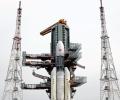
The Indian Space Research Organisation said that the countdown started at 6.51 am on Sunday.
Global analysts say a successful launch of operational GSLV MkII rocket will reduce dependency for ISRO on foreign launchers.

India's successful launch of its Mars mission has been described by the mainstream American media as "technological leap" and "a symbolic coup" against China in this field.

While the mission is a follow-up to the PSLV-C55 TeLEOS-2 mission launched in April this year, scientists in Sunday's mission will place the fourth stage of the PSLV rocket in a lower orbit.

As India prepares to launch its Rs 450 crore mission to Mars this year, a top space official says the country's first martian odyssey -- that has attracted some criticism -- is not just for pride but for undertaking "meaningful research".

ISRO, in a tweet, said EOS-04 was placed into an intended sun synchronous polar orbit of 529 km altitude at 6.17 am.

India scripted history by successfully launching EMISAT, a military satellite, and 28 foreign nano satellites on-board its polar rocket from Sriharikota on Monday, in a complex mission which marked many a first for Indian Space Research Organisation.

The announcement comes two days ahead of the proposed historic launch of the ISRO's 100th satellite along with 30 others in a single mission from Sriharikota.
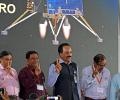
Ex-ISRO chairman G Madhavan Nair said the scientists at space agency have achieved this historic success by getting a salary one-fifth of the scientists in the developed world.

Pride is all ours and of those who made a beeline to Halls 3 and 5 that showcased indigenous defence technologies at the Make In India Week.

They made history for India and the world.

Godrej and some other firms are frustrated at what they say is the slow execution of projects and lack of government support, which are hampering India's efforts to compete with China and Russia as a cheaper option for launching satellites.

On the morning of February 15, ISRO will hurl into space using the Polar Satellite Launch Vehicle three Indian satellites and 101 small foreign satellites. No other country has ever tried to hit a century in a single mission.

A quick recap of the Mars Orbiter Mission's major milestones on the way to Mars
The success of the PSLV-C34 mission is a result of ISRO's professionalism and the hard work put in by their scientists over the last many decades., says Ajay Lele.

With the launch of GSLV-MK III, slated for April, it will be able to cater to bigger satellites as well.

It is important for India to develop multiple launch sites and become capable of undertaking more launches in a year's time, says Ajey Lele.

While the Mars mission got wide praise, there were voices which questioned the need for spending Rs 450-500 crore on it when the country is facing hunger and poverty.

A US court has asked Antrix Corporation, the commercial arm of Indian Space Research Organisation, to pay a compensation of USD 1.2 billion to a Bengaluru-based startup, Devas Multimedia, for cancelling a satellite deal in 2005.

The Trans-Lagrangian Point 1 Insertion manoeuvre marks the beginning of the spacecraft's about 110-day trajectory to the destination around the L1 Lagrange point, a balanced gravitational location between the Earth and the Sun.

The Lagrange point 1 (L1) of the Sun-Earth system is about 1.5 million km from the Earth. It is about one per cent of the total distance between the Earth and the Sun.
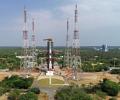
Days after landing on the Moon, India will aim for the Sun on Saturday with its maiden solar expedition, as ISRO's trusted PSLV will carry the Aditya L1 mission on a 125-day voyage to the Sun.
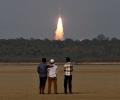
'The goal seems to be that we do not invest further in our system to make our system more accurate and more reliable or more global in reach,' an ISRO source tells Shivanand Kanavi.

The picture of Moon was taken by Chandrayaan-2's LI4 Camera from an altitude of about 2,650 km from the lunar surface.

An industrial house bred in old-school manufacturing values, Godrej & Boyce has displayed unusual agility to become a trusted builder of advanced weaponry, discovers Ajai Shukla.

Chandrayaan-3's success is a must for India's space ambitions; we can't afford to lose out. And for realising our space dreams, the Indian private sector must be encouraged because if we lose this race, the moon, Mars, and mineral-rich asteroids will already be crowded before we reach there.
'India has got a unique opportunity to get more and more business from outside as India is cost-effective and reliable.'
In his first interview, after the launch of MOM in Mars orbit, ISRO chief K Radhakrishnan spoke to T E Narasimhan about the mission and the way forward.
